Please enjoy the following extras ------ some short or sweet or banned or raw or all of the above
Some other selections of ART DIRECTION from the vault ...........
Plus other selections of PRODUCTION DESIGNS from the vault - energy that is grainy + blurry + raw ........
One movie that will not coming out of the vault.
Is the first film I designed.
Youtube has banned that movie.
🙂
Dial-Up, Pong, VCRs and mixtapes
Technology is dead long live technology
Confessions of a serial early adopter: A love-hate story
If you want to know how old I am in “tech years,” just know that I was programming on a PC in 1980. Back then, “graphical development” mostly meant making a green pixel blink slightly faster than the green pixel next to it. I was a digital guinea pig, and the laboratory was open.
For over four decades, I have been riding the bleeding edge of design technology—sometimes surfing the wave, sometimes crashing into the rocks, but always moving forward.
The Era of Loud Noises and Math (1987–1989)
By 1987, things got serious. I found myself in a tech lab helping develop maths coprocessing for AutoCAD®. If you don’t know what a maths coprocessor is, congratulations on having a social life in the 80s.
This led to the glory days of AutoCAD® Release 10 in 1988. We didn’t have silent laser printers; we had 6-pen plotters. These were robotic arms loaded with one of you pens that screamed like banshees while drawing circles. I rode that AutoCAD® wave through versions 11, 12, 13, 14, and 2000, watching with relief as plotters finally evolved into printers that didn’t sound like industrial accidents. By 1989, I was dabbling in PageMaker, because apparently, I needed to master the art of putting text next to pictures, too.
Steampunk Vibes and Invisible Magic (1992–1996)
In 1992, I had a brief identity crisis. Feeling retro—or perhaps just anticipating the Steampunk trend by thirty years—I operated an Oxberry animation stand for the short film Sotto Voce. The Oxberry was tactile, mechanical and a glorious controllable camera. Animating one cell at a time. I kept that retro energy going with blue screens, working with composition operators who were basically wizards.
By 1993, I was a VFX designer and supervisor before it was cool enough to get you free drinks at parties. I worked on the silent film homage Precious. The goal? INVISIBLE special effects. That’s right. My job was to work incredibly hard to make sure nobody noticed I had done anything at all but to enforce the story.
Then came 1996. I installed Windows 97. Experts said society was developing “emotional responses” to computers then. They were right. My emotional response was pure, unadulterated rage directed at a very annoying paperclip. I immediately began plotting the demise of Clippy. I like to think my spiritual contribution helped send that eyebrows-raising wire-pest to the digital graveyard.
Hollywood Calling (1999–present)
The millennium turned, and I went 3D. I picked up 3D Studio Max in 1999 for modelling. By 2001, MiniCAD had morphed into Vectorworks, and I used it to design sets for The Bourne Identity. (I can neither confirm nor deny if I designed an escape route for Matt Damon. I’d like to call a lawyer please).
In 2003, I fell in love with SketchUp 5. This was the golden age—Pre-Google, and certainly way before the “Trimble death spiral.” I used the glorious PushPull tool to design sets for King Arthur. Who needs a round table when you have polygon modelling?
The Cloud Betrayal and The Future (2011–2025)
2011 was the year I learned a hard lesson: The Cloud is just someone else’s computer that hates you. I used Dropbox. Then soon after stopped using Dropbox. There is nothing quite as soul-crushing as watching another grown professional weep while “syncing errors” (read: another remote user) delete months of their work. I vowed to keep my files on prem and local.
I pivoted to making things I could actually touch, releasing the first range of 3D printed jewellery in 2013. But the digital siren song called me back. By 2019, I was using LIDAR to scan a massive 63m x 45m x 9m high site for Project Icon. Cameras and lasers again.
Then, machine learnings moment truly arrived. 2021: Autoregressive models. Transformers. The artist formerly known as “too complicated and too expensive” now known as ChatGPT. I dove in.
2022 brought me to the LED volumes for Serpent Queen S2. I saw the good, the bad, and the very ugly of the Unreal Engine. Saw that if you want to use that you want to restructure completely post into pre. Welcome to a different process and budget.
2024 has me generating 3D models out of thin air with AI, and in 2025, I’m using AI for set design on The Tale for Publicis.
And now? From 6-pen plotters to Generative AI, I’ve seen a lot of changes. And I’m still looking searching, early researching and developing. Onward and upward. (Just don’t ask me to install a paperclip assistant).
….
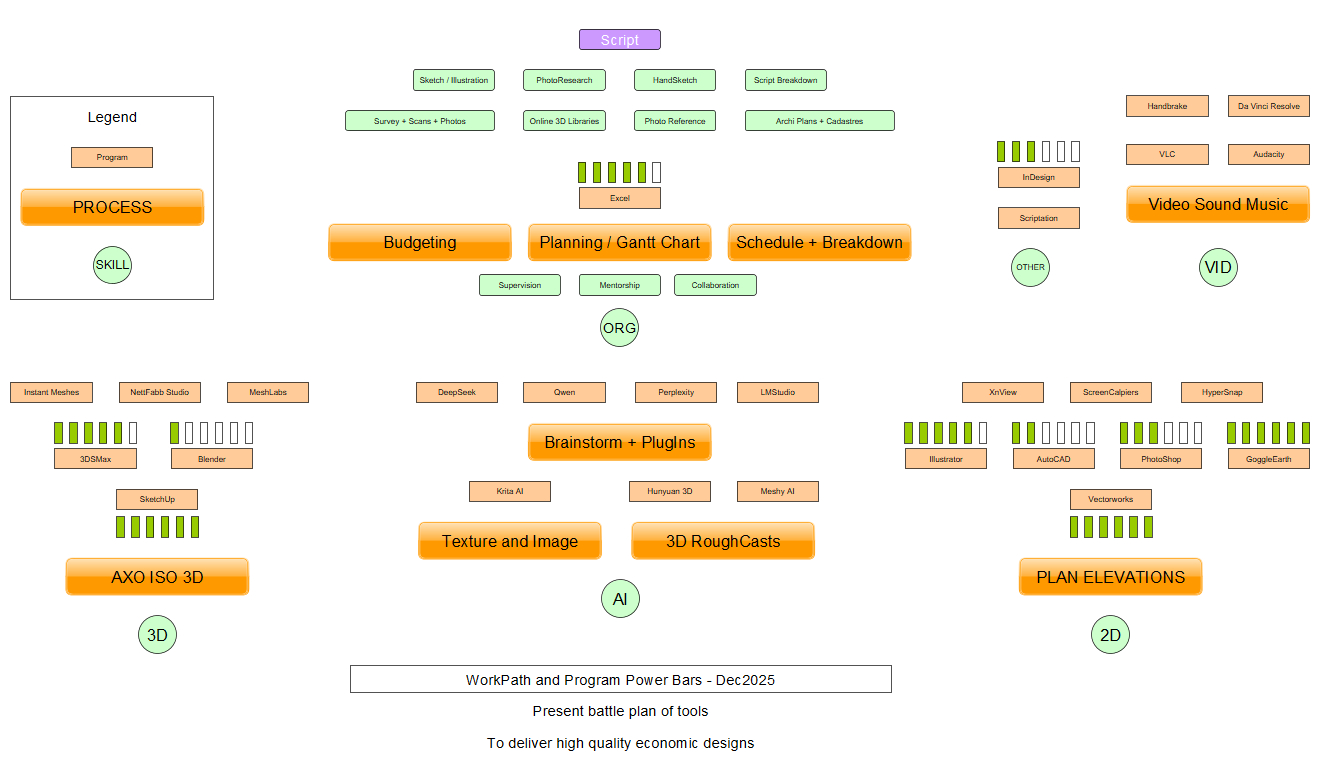
WorkPath with PowerBars